
"The Gospel in Action"
Dear friend, you are being faithful to God when you care for the traveling teachers who pass through, even though they are strangers to you. They have told the church here of your loving friendship. Please continue providing for such teachers in a manner that pleases God. For they are traveling for the Lord, and they accept nothing from people who are not believers. So we ourselves should support them so that we can be their partners as they teach the truth. – 3 John 11-14 (NLT)
I don't even know if they have "summer re-runs" anymore, but I hope that my sharing some thoughts occasioned by the past Sunday's sermon at the Etna Church isn't construed as a re-run.
On July 26th our guest preacher, Lindsay Whaley, shared a striking message focusing on... 3 John. Not John 3, but rather one of the three epistles attributed to "the disciple Jesus loved", John (the Elder). John was likely old indeed when he wrote these letters, and was literally the only one of the Twelve who, by God's grace, lived long enough to reflect on amazing events he experienced first hand and to consider the state of the fledgling but Spirit-fueled growth of "the Way", which we all now know as the Christian church.
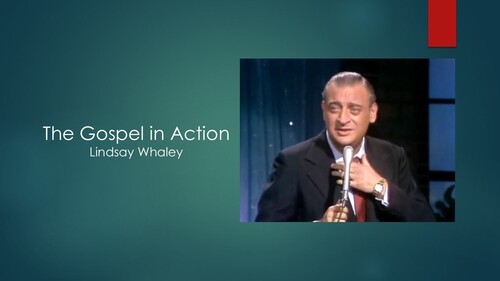
Prof. Whaley caught my attention early on, when he referred to 3 John as "the Rodney Dangerfield of Scripture"! No respect. But his goal that morning was to change a congregation's collective mind about this little letter – the shortest book in all of Scripture, addressing no doctrinal issues, containing no (obvious) teachings, and not even mentioning the name of Jesus, nor His title, Christ.
Since you can watch the entire sermon on demand – and I'd encourage you to do so; just click here to find it – I will refrain from an extensive review. I'll just cut to the chase: This short and very personal letter from one believer (John) to another (Gaius) packs a punch. We can read, digest, and debate doctrine. Our heads can be full of "Christian" thoughts. But how do we live the Gospel? Paul, uncharacteristically, expresses it succinctly: When God’s people are in need, be ready to help them. Always be eager to practice hospitality. (Romans 12:13). Lindsay Whaley argues persuasively that John, using a few more words, makes the same point in his third epistle. The essence of the Gospel, lived out by the Body of Christ (that is, the church) is to practice hospitality.
This message is all well and good, but what do we take home from it and "reduce to practice"? Again, I'll refer you to his sermon for details... but I want to re-emphasize one thing from his message. Prof. Whaley concludes his sermon with a few minutes of what friends in Baltimore like to call "SLAM" -- Sunday's Message, Applied on Monday.
He noted that, in the Upper Valley in 2026, we're not seeing too many itinerant preachers wander in. So, what are we supposed to do today? Defining hospitality helps: We practice hospitality "when we offer any concrete expression of love that seeks to make another person feel valued, safe, welcome, nourished." With, I think, a note of suppressed glee, he referred to hospitality as "a very subversive activity". It cuts against the grain of 'civilized culture': removing barriers that make people feel excluded, unwelcome, unloved.
I'm reminded of Proverbs 25:21-22:
If your enemies are hungry, give them food to eat.
If they are thirsty, give them water to drink.
You will heap burning coals of shame on their heads,
and the Lord will reward you.
But the message of 3 John isn't about shame, and we're not being called to make others feel guilty. We are being called, as Lindsay Whaley pointed out, to strive to meet the physical, emotional, and spiritual needs of others on their own terms – because that is exactly what God has done for us. Said Prof. Whaley: Seeing hospitality this way turns it into a lens of how we live our lives. It helps us recognize our dependence on God.
This is where the rubber meets the road, so to speak, when it comes to practicing Christianity as a daily activity in a broken world. It's easy to be nice to, and to do nice things for, people we like. People who "look" like us. It gets incrementally harder to do it for people we don't know, people who don't look like us, people who we don't like.
Here's the deal, though. We're all creatures created in the image of God. Even the people I don't like. Listening to the sermon, I was thinking of my buddy in Christ, Tom Johansen (whom I do like -- just to be clear about that!), reflecting on Genesis 2:27: So God created human beings in his own image. In the image of God he created them; male and female he created them. Tom also reflects often on Augustine's notion of the Imago Dei, that image of God that we all carry. I also thought of Tom quoting CS Lewis: There are no ordinary people. You have never talked to a mere mortal (from The Weight of Glory).
To quote "Pig-Pen" (of Peanuts fame, not the Grateful Dead's first keyboard player): "Kind of makes you want to treat me with more respect, doesn't it?" So much for equating 3 John and Rodney Dangerfield, I suppose!
But... Imago Dei notwithstanding, really, truly "practicing hospitality" is not easy. It requires, as Lindsay said, courage, practice, accepting one's ability to fail (and trying anyway), and humility. I don't know about you, but all of those remain development areas for me! Lindsay quoted Edith Schaefer: “It is not sinful to be finite and limited”, adding, "but we should [I'd say we must] always be willing to do something. Be willing to do something in the name of Jesus."
Practice hospitality.
On July 26th our guest preacher, Lindsay Whaley, shared a striking message focusing on... 3 John. Not John 3, but rather one of the three epistles attributed to "the disciple Jesus loved", John (the Elder). John was likely old indeed when he wrote these letters, and was literally the only one of the Twelve who, by God's grace, lived long enough to reflect on amazing events he experienced first hand and to consider the state of the fledgling but Spirit-fueled growth of "the Way", which we all now know as the Christian church.
Prof. Whaley caught my attention early on, when he referred to 3 John as "the Rodney Dangerfield of Scripture"! No respect. But his goal that morning was to change a congregation's collective mind about this little letter – the shortest book in all of Scripture, addressing no doctrinal issues, containing no (obvious) teachings, and not even mentioning the name of Jesus, nor His title, Christ.
Since you can watch the entire sermon on demand – and I'd encourage you to do so; just click here to find it – I will refrain from an extensive review. I'll just cut to the chase: This short and very personal letter from one believer (John) to another (Gaius) packs a punch. We can read, digest, and debate doctrine. Our heads can be full of "Christian" thoughts. But how do we live the Gospel? Paul, uncharacteristically, expresses it succinctly: When God’s people are in need, be ready to help them. Always be eager to practice hospitality. (Romans 12:13). Lindsay Whaley argues persuasively that John, using a few more words, makes the same point in his third epistle. The essence of the Gospel, lived out by the Body of Christ (that is, the church) is to practice hospitality.
This message is all well and good, but what do we take home from it and "reduce to practice"? Again, I'll refer you to his sermon for details... but I want to re-emphasize one thing from his message. Prof. Whaley concludes his sermon with a few minutes of what friends in Baltimore like to call "SLAM" -- Sunday's Message, Applied on Monday.
He noted that, in the Upper Valley in 2026, we're not seeing too many itinerant preachers wander in. So, what are we supposed to do today? Defining hospitality helps: We practice hospitality "when we offer any concrete expression of love that seeks to make another person feel valued, safe, welcome, nourished." With, I think, a note of suppressed glee, he referred to hospitality as "a very subversive activity". It cuts against the grain of 'civilized culture': removing barriers that make people feel excluded, unwelcome, unloved.
I'm reminded of Proverbs 25:21-22:
If your enemies are hungry, give them food to eat.
If they are thirsty, give them water to drink.
You will heap burning coals of shame on their heads,
and the Lord will reward you.
But the message of 3 John isn't about shame, and we're not being called to make others feel guilty. We are being called, as Lindsay Whaley pointed out, to strive to meet the physical, emotional, and spiritual needs of others on their own terms – because that is exactly what God has done for us. Said Prof. Whaley: Seeing hospitality this way turns it into a lens of how we live our lives. It helps us recognize our dependence on God.
This is where the rubber meets the road, so to speak, when it comes to practicing Christianity as a daily activity in a broken world. It's easy to be nice to, and to do nice things for, people we like. People who "look" like us. It gets incrementally harder to do it for people we don't know, people who don't look like us, people who we don't like.
Here's the deal, though. We're all creatures created in the image of God. Even the people I don't like. Listening to the sermon, I was thinking of my buddy in Christ, Tom Johansen (whom I do like -- just to be clear about that!), reflecting on Genesis 2:27: So God created human beings in his own image. In the image of God he created them; male and female he created them. Tom also reflects often on Augustine's notion of the Imago Dei, that image of God that we all carry. I also thought of Tom quoting CS Lewis: There are no ordinary people. You have never talked to a mere mortal (from The Weight of Glory).
To quote "Pig-Pen" (of Peanuts fame, not the Grateful Dead's first keyboard player): "Kind of makes you want to treat me with more respect, doesn't it?" So much for equating 3 John and Rodney Dangerfield, I suppose!
But... Imago Dei notwithstanding, really, truly "practicing hospitality" is not easy. It requires, as Lindsay said, courage, practice, accepting one's ability to fail (and trying anyway), and humility. I don't know about you, but all of those remain development areas for me! Lindsay quoted Edith Schaefer: “It is not sinful to be finite and limited”, adding, "but we should [I'd say we must] always be willing to do something. Be willing to do something in the name of Jesus."
Practice hospitality.
All the believers devoted themselves to the apostles’ teaching, and to fellowship, and to sharing in meals (including the Lord’s Supper[i]), and to prayer.
A deep sense of awe came over them all, and the apostles performed many miraculous signs and wonders. And all the believers met together in one place and shared everything they had. They sold their property and possessions and shared the money with those in need. They worshiped together at the Temple each day, met in homes for the Lord’s Supper, and shared their meals with great joy and generosity — all the while praising God and enjoying the goodwill of all the people. And each day the Lord added to their fellowship those who were being saved. – Acts 2:42-47 (NLT)

Recent
Archive
2026
2025
January
February
March
April
May
June
September
2024
January
February
March
May
July
August
September
October
November
No Comments