
Sign, Sign, Everywhere a Sign

Image above taken from the original opening credits of The Chosen:
https://watch.thechosen.tv/
And the sign said, "Everybody welcome. Come in, kneel down and pray"
But when they passed around the plate at the end of it all,
I didn't have a penny to pay
So I got me a pen and a paper and I made up my own little sign
I said, "Thank you, Lord, for thinkin' 'bout me. I'm alive and doin' fine."
Some of you reading this just might be old enough (I am!) to remember a 1970 hit song by a Canadian band, The Five Man Electrical Band, called Signs.
Here's a link to the original: https://youtu.be/oeT5otk2R1g?si=vfPKQAZaUNTPml_j
And even if you’re not that old, you might remember a 1990 acoustic cover of the song by a San Francisco Bay Area group called (somewhat ironically, considering the current use of name) Tesla. The band spiced up the lyrics in that live recording a little bit too much to share in a church blog post, but a little sleuthing turned up a “clean” version recorded in 2019 (?!) by Tesla performing in the redoubtable Abbey Road studios in London.
Here's a link: https://youtu.be/VzreWpBusWg?si=gSmfjx7WxZVGQVP0
There’s precious little theology in the song, but I do want to share a few thoughts about signs, or more to the point, symbols, in Christianity. There are many symbols to be found in churches: the Cross, of course, but also things like a shell -- sometimes dripping water (baptism), three interlocking circles representing the Trinity, the dove or a tongue of flame (the Holy Spirit), etc. Here, I want to focus on one sign/symbol in particular: the Fish.
The driver for this was a conversation at our Wednesday morning Bible discussion that had somehow wandered onto the Christian “fish” symbol. Drawing on my (ahem) extensive religious education (i.e., something I remembered from 7th grade Religion class in Jr. High School), I noted that the symbol of a fish had been used by early Christians (followers of “The Way”, as it was known) to identify themselves to each other. But why a fish?
Was it an allusion to Jesus’ quip to two local fishermen, Peter and Andrew, whom He invited to join Him in His mission: “Follow me, and I will make you fishers of men.” (Matthew 4:19b, RSV). Perhaps it was a sly reference to Jesus’ miraculous feeding of 5,000 men (not to mention women and children!) with five crowdsourced loaves of bread and two fish? That was an important miracle, to be sure: it’s reputed to be the only one (excluding the Resurrection) recorded in all four Gospels (Matthew 14, Mark 6, Luke 9, and John 6). It was also a turning point of sorts for Jesus' ministry: suddenly He had many new followers keen to be fed by this emergent Bread King. Palm Sunday, Good Friday, and Easter Sunday were suddenly all looming on the horizon.
But, again: why a fish?
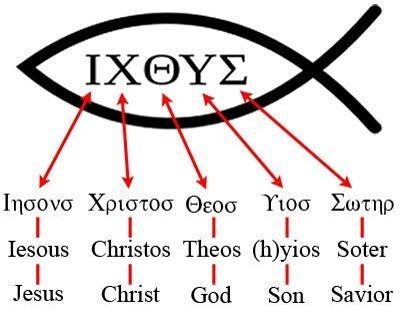
The classical Greek word for a generic fish is ἰχθύς (ichthys). Early Christians adopted a fish symbol as their code – to identify themselves (to each other), and perhaps also as a way to identify their places of worship in a clandestine fashion. The symbol invited the savvy viewer to consider ἰχθύς as an acronym.
Here's a link to the original: https://youtu.be/oeT5otk2R1g?si=vfPKQAZaUNTPml_j
And even if you’re not that old, you might remember a 1990 acoustic cover of the song by a San Francisco Bay Area group called (somewhat ironically, considering the current use of name) Tesla. The band spiced up the lyrics in that live recording a little bit too much to share in a church blog post, but a little sleuthing turned up a “clean” version recorded in 2019 (?!) by Tesla performing in the redoubtable Abbey Road studios in London.
Here's a link: https://youtu.be/VzreWpBusWg?si=gSmfjx7WxZVGQVP0
There’s precious little theology in the song, but I do want to share a few thoughts about signs, or more to the point, symbols, in Christianity. There are many symbols to be found in churches: the Cross, of course, but also things like a shell -- sometimes dripping water (baptism), three interlocking circles representing the Trinity, the dove or a tongue of flame (the Holy Spirit), etc. Here, I want to focus on one sign/symbol in particular: the Fish.
The driver for this was a conversation at our Wednesday morning Bible discussion that had somehow wandered onto the Christian “fish” symbol. Drawing on my (ahem) extensive religious education (i.e., something I remembered from 7th grade Religion class in Jr. High School), I noted that the symbol of a fish had been used by early Christians (followers of “The Way”, as it was known) to identify themselves to each other. But why a fish?
Was it an allusion to Jesus’ quip to two local fishermen, Peter and Andrew, whom He invited to join Him in His mission: “Follow me, and I will make you fishers of men.” (Matthew 4:19b, RSV). Perhaps it was a sly reference to Jesus’ miraculous feeding of 5,000 men (not to mention women and children!) with five crowdsourced loaves of bread and two fish? That was an important miracle, to be sure: it’s reputed to be the only one (excluding the Resurrection) recorded in all four Gospels (Matthew 14, Mark 6, Luke 9, and John 6). It was also a turning point of sorts for Jesus' ministry: suddenly He had many new followers keen to be fed by this emergent Bread King. Palm Sunday, Good Friday, and Easter Sunday were suddenly all looming on the horizon.
But, again: why a fish?
The classical Greek word for a generic fish is ἰχθύς (ichthys). Early Christians adopted a fish symbol as their code – to identify themselves (to each other), and perhaps also as a way to identify their places of worship in a clandestine fashion. The symbol invited the savvy viewer to consider ἰχθύς as an acronym.
Source: https://www.facebook.com/groups/pastorbobjoyce/posts/1515737685619589/ (via Google)
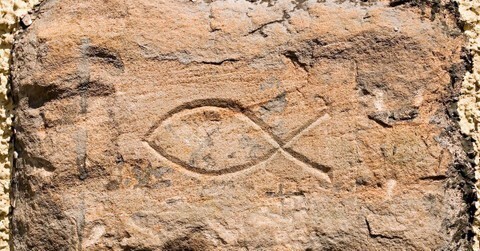
The fish was a simple but effective sign for believers to identify themselves to each other and, perhaps, also a tool to keep out dangerous unbelievers. Interestingly, the cross would have been a very risky choice. "Good" Roman citizens and, of course, the relevant authorities knew of the "fables" surrounding the prophet who'd founded "The Way": executed by the Empire as a dangerous revolutionary in the most grotesque manner available, but reputed to have come back to life! No, the cross was too obvious. The fish was more subtle, more arcane. There were even other, less controversial (?!) pagan religions that used fish symbols - albeit not in the same manner as the early Christians.
The fish symbol could even be used as a “secret handshake” of sorts. One Christian could draw ½ of the symbol; another believer would know how to finish it!
But – and I think this is important – the symbol could also be used as a teaching tool – essentially a pictorial creed, boiling the Gospel down to its essence: We believe in Jesus the Christ [that is the Messiah, promised of old by God to His people], God’s Son and our Savior. So there was lots of utility and even "Christian education" packed into an elegantly simple (and easy to draw!) symbol.
The signs and symbols of the church are important, steeped in meaning and tradition. But, like the fish symbol of old, I think they can sometimes be a double-edged sword. We see the fish stuck on the bumpers of cars, but the drivers might sometimes seem to manifest un-Christian values! We also see parodies of the fish (e.g., the "Darwin" fish, with its little legs, and even the "Flying Spaghetti Monster").
But there's another potential problem with our "signs". We might know what they mean, but a visitor might not. If we're the insiders, we run the risk, I think, of making a visitor – a seeker – feel like an outsider, maybe without even realizing it.
Today’s church, at least in the United States, isn’t (well, maybe it isn’t!) too concerned with trying to hide from enemies. In fact, the current climate seems to call for redoubled efforts to reach out to those who are seeking something, but who don’t quite know what. God’s Church knows what they seek! If we invoke symbols without also sharing some context, we may confound people who simply need the Lord.
Conversely, though, if we view and then use the symbols of the church as teachable moments, perhaps we can use them to raise interest and awareness on the part of seekers. They are exactly the people whom Jesus instructed His followers to focus on in some of His last instructions to them - and transmitted on down to us: known through the ages as the Great Commission.
The fish symbol could even be used as a “secret handshake” of sorts. One Christian could draw ½ of the symbol; another believer would know how to finish it!
But – and I think this is important – the symbol could also be used as a teaching tool – essentially a pictorial creed, boiling the Gospel down to its essence: We believe in Jesus the Christ [that is the Messiah, promised of old by God to His people], God’s Son and our Savior. So there was lots of utility and even "Christian education" packed into an elegantly simple (and easy to draw!) symbol.
The signs and symbols of the church are important, steeped in meaning and tradition. But, like the fish symbol of old, I think they can sometimes be a double-edged sword. We see the fish stuck on the bumpers of cars, but the drivers might sometimes seem to manifest un-Christian values! We also see parodies of the fish (e.g., the "Darwin" fish, with its little legs, and even the "Flying Spaghetti Monster").
But there's another potential problem with our "signs". We might know what they mean, but a visitor might not. If we're the insiders, we run the risk, I think, of making a visitor – a seeker – feel like an outsider, maybe without even realizing it.
Today’s church, at least in the United States, isn’t (well, maybe it isn’t!) too concerned with trying to hide from enemies. In fact, the current climate seems to call for redoubled efforts to reach out to those who are seeking something, but who don’t quite know what. God’s Church knows what they seek! If we invoke symbols without also sharing some context, we may confound people who simply need the Lord.
Conversely, though, if we view and then use the symbols of the church as teachable moments, perhaps we can use them to raise interest and awareness on the part of seekers. They are exactly the people whom Jesus instructed His followers to focus on in some of His last instructions to them - and transmitted on down to us: known through the ages as the Great Commission.
Then Jesus came to them and said, “All authority in heaven and on earth has been given to me. Therefore go and make disciples of all nations, baptizing them in the name of the Father and of the Son and of the Holy Spirit, and teaching them to obey everything I have commanded you. And surely I am with you always, to the very end of the age.” – Matthew 28:19-20 (NIV)
Recent
Archive
2026
2025
January
February
March
April
May
June
September
2024
January
February
March
May
July
August
September
October
November
No Comments