On Thursday, April 2, we will commemorate Jesus' institution of Holy Communion (known also as The Lord's Supper or the Eucharist) at a special Maundy Thursday evening service (7 pm) in Trumbull Hall at the Etna church. Our service will focus on Scripture readings and a celebration of Communion "in remembrance of Him".
The New Testament records the basic story of Maundy Thursday in the "synoptic Gospels" (Luke 22:7-38, Matthew 26:17-35, and Mark 14:12-31). "The disciple Jesus loved" takes a deep dive into that Thursday evening. In John 13-17, the disciple named John, one of Jesus' inner circle with Peter and James, shares a moving eyewitness account of Jesus' words and actions in his "last supper" with His disciples. The term Maundy Thursday comes from the Latin mandatum ("command") which is taken from John 13:34-35: "So now I am giving you a new commandment: Love each other. Just as I have loved you, you should love each other. Your love for one another will prove to the world that you are my disciples.”
There was a lot more going on at the Passover supper that Thursday evening in the Upper Room than sharing of food and drink! Jesus predicts the near future – His betrayal by one of his own disciples, and the three denials that another would soon utter out of fear for his own life ( a completely irrational fear considering the identity of that disciple's rabbi). For Christians today, though, perhaps the greatest gift of the events of Maundy Thursday was to explain the events of the first Passover, when God spared the firstborn children of the faithful Children of Israel who'd obeyed His commands, killed a lamb without blemish, then eaten a (rather hasty) meal and painted their door frames with the blood of the lamb. On this particular Thursday night, God's true Lamb, without blemish, was poised to shed His blood on our behalf, so that Death would pass over us once and for all, in the reunification of humankind with the God who created us.
On that Thursday night, as John tells it, Jesus also was focused on the welfare and education of His team. He was leaving them behind to carry on His work in the world. They would be enabled and empowered through the Holy Spirit at Pentecost, but in the moment, in a borrowed upper room, they were confused and, increasingly, afraid of what the future had in store for them.
But near the end of the meal, they were catching on: As John writes (John 16:29-33, NLT):
Then his disciples said, “At last you are speaking plainly and not figuratively. Now we understand that you know everything, and there’s no need to question you. From this we believe that you came from God.”
Jesus asked, “Do you finally believe? But the time is coming—indeed it’s here now—when you will be scattered, each one going his own way, leaving me alone. Yet I am not alone because the Father is with me. I have told you all this so that you may have peace in me. Here on earth you will have many trials and sorrows. But take heart, because I have overcome the world.”
Note that Jesus' words above aren't in the future tense. Not I will overcome the world (i.e., sin, death, and the Devil), but I have overcome the world. Are there any more comforting and at the same time motivating words for us than those? As Paul would later write: If God is for us, who can ever be against us? (Romans 8:31b, NLT).
On Thursday night, Jesus' redemptive work was almost finished. But the last gasps of the world's "power" would be agonizing for Him to bear on our behalf. Nonetheless, He took time to reassure and educate His disciples about the new covenant that He was bringing to the world. This week, I'd encourage us all to reflect on all of these things. If the opportunity presents itself, read John 13-17 in your preferred Bible translation. https://www.biblegateway.com/ is an easy way to do this, or you can use an app such as YouVersion – or, of course, you can choose to read a "hardcopy" Bible! These chapters in John's Gospel share Jesus' valediction, and it's powerful and inspiring to read. You might also want to read Paul's stirring assessment of life in the Spirit as found in Romans 8 (the Scripture that literally inspired the Protestant Reformation). The essence of the Gospel in and through which we live and hope may be found in these passages. I hope we see you in Trumbull Hall on Thursday evening, and I pray for a blessed Easter season for all.
– Mark Hardy, on behalf of "The Etna Church"
The New Testament records the basic story of Maundy Thursday in the "synoptic Gospels" (Luke 22:7-38, Matthew 26:17-35, and Mark 14:12-31). "The disciple Jesus loved" takes a deep dive into that Thursday evening. In John 13-17, the disciple named John, one of Jesus' inner circle with Peter and James, shares a moving eyewitness account of Jesus' words and actions in his "last supper" with His disciples. The term Maundy Thursday comes from the Latin mandatum ("command") which is taken from John 13:34-35: "So now I am giving you a new commandment: Love each other. Just as I have loved you, you should love each other. Your love for one another will prove to the world that you are my disciples.”
There was a lot more going on at the Passover supper that Thursday evening in the Upper Room than sharing of food and drink! Jesus predicts the near future – His betrayal by one of his own disciples, and the three denials that another would soon utter out of fear for his own life ( a completely irrational fear considering the identity of that disciple's rabbi). For Christians today, though, perhaps the greatest gift of the events of Maundy Thursday was to explain the events of the first Passover, when God spared the firstborn children of the faithful Children of Israel who'd obeyed His commands, killed a lamb without blemish, then eaten a (rather hasty) meal and painted their door frames with the blood of the lamb. On this particular Thursday night, God's true Lamb, without blemish, was poised to shed His blood on our behalf, so that Death would pass over us once and for all, in the reunification of humankind with the God who created us.
On that Thursday night, as John tells it, Jesus also was focused on the welfare and education of His team. He was leaving them behind to carry on His work in the world. They would be enabled and empowered through the Holy Spirit at Pentecost, but in the moment, in a borrowed upper room, they were confused and, increasingly, afraid of what the future had in store for them.
But near the end of the meal, they were catching on: As John writes (John 16:29-33, NLT):
Then his disciples said, “At last you are speaking plainly and not figuratively. Now we understand that you know everything, and there’s no need to question you. From this we believe that you came from God.”
Jesus asked, “Do you finally believe? But the time is coming—indeed it’s here now—when you will be scattered, each one going his own way, leaving me alone. Yet I am not alone because the Father is with me. I have told you all this so that you may have peace in me. Here on earth you will have many trials and sorrows. But take heart, because I have overcome the world.”
Note that Jesus' words above aren't in the future tense. Not I will overcome the world (i.e., sin, death, and the Devil), but I have overcome the world. Are there any more comforting and at the same time motivating words for us than those? As Paul would later write: If God is for us, who can ever be against us? (Romans 8:31b, NLT).
On Thursday night, Jesus' redemptive work was almost finished. But the last gasps of the world's "power" would be agonizing for Him to bear on our behalf. Nonetheless, He took time to reassure and educate His disciples about the new covenant that He was bringing to the world. This week, I'd encourage us all to reflect on all of these things. If the opportunity presents itself, read John 13-17 in your preferred Bible translation. https://www.biblegateway.com/ is an easy way to do this, or you can use an app such as YouVersion – or, of course, you can choose to read a "hardcopy" Bible! These chapters in John's Gospel share Jesus' valediction, and it's powerful and inspiring to read. You might also want to read Paul's stirring assessment of life in the Spirit as found in Romans 8 (the Scripture that literally inspired the Protestant Reformation). The essence of the Gospel in and through which we live and hope may be found in these passages. I hope we see you in Trumbull Hall on Thursday evening, and I pray for a blessed Easter season for all.
– Mark Hardy, on behalf of "The Etna Church"
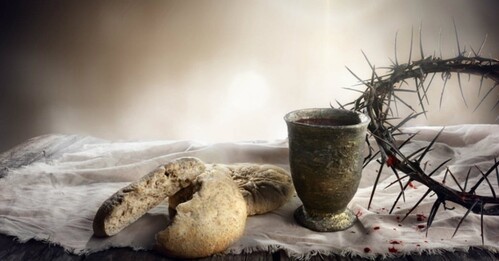
For I received from the Lord what I also passed on to you: The Lord Jesus, on the night he was betrayed, took bread, and when he had given thanks, he broke it and said, “This is my body, which is for you; do this in remembrance of me.” In the same way, after supper he took the cup, saying, “This cup is the new covenant in my blood; do this, whenever you drink it, in remembrance of me.” For whenever you eat this bread and drink this cup, you proclaim the Lord’s death until he comes.
So then, whoever eats the bread or drinks the cup of the Lord in an unworthy manner will be guilty of sinning against the body and blood of the Lord. Everyone ought to examine themselves before they eat of the bread and drink from the cup. For those who eat and drink without discerning the body of Christ eat and drink judgment on themselves. That is why many among you are weak and sick, and a number of you have fallen asleep. But if we were more discerning with regard to ourselves, we would not come under such judgment. Nevertheless, when we are judged in this way by the Lord, we are being disciplined so that we will not be finally condemned with the world. – 1 Corinthians 11:23-32 (ESV)