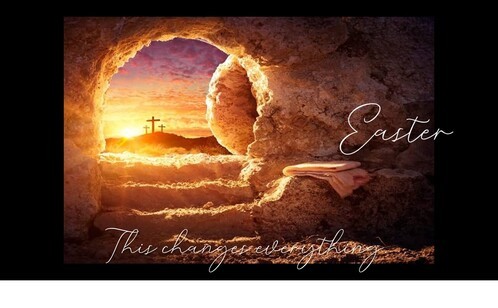
This changes everything.
Therefore, since we are surrounded by so great a cloud of witnesses, let us also lay aside every weight, and sin which clings so closely, and let us run with endurance the race that is set before us, looking to Jesus, the founder and perfecter of our faith, who for the joy that was set before him endured the cross, despising the shame, and is seated at the right hand of the throne of God. – Hebrews 12:1-2 (ESV)
I tend to be one of those deadline-driven people. Much to my chagrin, I work better under pressure. More pressure, more betterer. Which is part of the reason I'm writing some thoughts about the most important event in history (to borrow from Jim van Yperen's outstanding Easter Sunday sermon) fully two weeks after Easter Sunday.
But I have an excuse. Easter was an event in history, but it wasn't a day, or even an event - that instant that the stone rolled back and the the Messiah exited the tomb that could not hold Him. Easter is (not was) a new reality. I'm going to go out on a metaphorical limb now and share a notion (a model) of the singular impact of Easter on mankind.
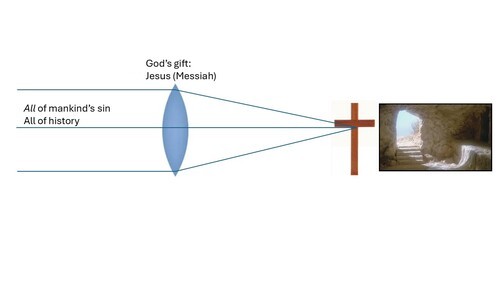
Think of a magnifying glass. A magnifying glass is a convex lens, and a convex lens has the unique and useful property of focusing the light that passes through it. All of the light pouring through a convex lens focuses on a single point. Now, imagine that the convex lens is God's singular and gracious gift of His son, Jesus Christ, in the flesh in Bethlehem.
Jesus lives, gathers disciples, travels, preaches. He perform miracles, He illuminates the Scriptures, He convicts the faithless and the hypocrites, He raises the dead. His earthly life and ministry focuses everything on a singular point. Everything. All of mankind's rebellion, our sin, the whole of what we call history – past, present, and yet to come – focuses on one point: the cross. And, immediately adjacent (in the great scheme of things) to that cross and the death of the Messiah, an empty tomb. A perfect sacrificial Lamb, sacrificed to to pay for our sin (tetelestai). And raised again to everlasting life on Easter morning.
In optics, we call the image formed by a convex lens at its focus a real image, which means that, if we put a piece of paper at that point, we'll see what the lens sees. The image is projected for our enjoyment. I'm not sure my metaphor is stretchy enough to accommodate this, but I'll suggest that the focus of Easter recreates for us not a real image, but in fact recreates reality. The reality God always intended: union and harmony between God and His creation. After Easter, nothing remains the way it was before. Picture that!
Now, back to that title! It's not original to me (not much is...), but with the breathlessness of a movie trailer, the phrase resonates with the singular focus of Easter, and what it brings to us. But don't misinterpret that big message. We don't live a reverberant echo of Easter – echoes decay. We live in Easter. Present tense. We are, as some churches like to put it, Easter people. That's why we worship principally on Sundays, celebrating the gift that saves us on the day that completely fulfilled it. And that reality means that we live in the joyous hope of an eternity in the presence of God.
This.
Changes.
Everything.
But I have an excuse. Easter was an event in history, but it wasn't a day, or even an event - that instant that the stone rolled back and the the Messiah exited the tomb that could not hold Him. Easter is (not was) a new reality. I'm going to go out on a metaphorical limb now and share a notion (a model) of the singular impact of Easter on mankind.
Think of a magnifying glass. A magnifying glass is a convex lens, and a convex lens has the unique and useful property of focusing the light that passes through it. All of the light pouring through a convex lens focuses on a single point. Now, imagine that the convex lens is God's singular and gracious gift of His son, Jesus Christ, in the flesh in Bethlehem.
Jesus lives, gathers disciples, travels, preaches. He perform miracles, He illuminates the Scriptures, He convicts the faithless and the hypocrites, He raises the dead. His earthly life and ministry focuses everything on a singular point. Everything. All of mankind's rebellion, our sin, the whole of what we call history – past, present, and yet to come – focuses on one point: the cross. And, immediately adjacent (in the great scheme of things) to that cross and the death of the Messiah, an empty tomb. A perfect sacrificial Lamb, sacrificed to to pay for our sin (tetelestai). And raised again to everlasting life on Easter morning.
In optics, we call the image formed by a convex lens at its focus a real image, which means that, if we put a piece of paper at that point, we'll see what the lens sees. The image is projected for our enjoyment. I'm not sure my metaphor is stretchy enough to accommodate this, but I'll suggest that the focus of Easter recreates for us not a real image, but in fact recreates reality. The reality God always intended: union and harmony between God and His creation. After Easter, nothing remains the way it was before. Picture that!
Now, back to that title! It's not original to me (not much is...), but with the breathlessness of a movie trailer, the phrase resonates with the singular focus of Easter, and what it brings to us. But don't misinterpret that big message. We don't live a reverberant echo of Easter – echoes decay. We live in Easter. Present tense. We are, as some churches like to put it, Easter people. That's why we worship principally on Sundays, celebrating the gift that saves us on the day that completely fulfilled it. And that reality means that we live in the joyous hope of an eternity in the presence of God.
This.
Changes.
Everything.
So now there is no condemnation for those who belong to Christ Jesus. And because you belong to him, the power of the life-giving Spirit has freed you from the power of sin that leads to death. The law of Moses was unable to save us because of the weakness of our sinful nature. So God did what the law could not do. He sent his own Son in a body like the bodies we sinners have. And in that body God declared an end to sin’s control over us by giving his Son as a sacrifice for our sins. He did this so that the just requirement of the law would be fully satisfied for us, who no longer follow our sinful nature but instead follow the Spirit. – 1 Romans 8:1-4 (NLT)
Recent
Archive
2026
2025
January
February
March
April
May
June
September
2024
January
February
March
May
July
August
September
October
November
No Comments